Which Jellyfish Coloring Pages Is Right for Your Child?
Every page above has a difficulty label, and this quick guide shows what each level means in practice.
| Level |
Ages |
What to expect |
Good first page |
| Easiest |
2–4 |
Thick outlines, big shapes, almost no background |
Big Smiley Jellyfish |
| Easy |
3–7 |
Simple scenes with a few small details |
Sleeping Jellyfish on a Cloud |
| Medium |
5–9 |
Backgrounds, patterns on the bell, more to fill |
Explorer Jellyfish on a Coral Reef Adventure |
| Detailed |
7+ and teens |
Busy reefs, overlapping tentacles, small spaces |
Jellyfish Over the Coral Reef |
| Adult |
Teens and adults |
Mandalas and zentangle patterns |
Intricate Mandala Jellyfish |
If a child gets frustrated halfway through, drop down one level for the next page. Finishing an easier page feels much better than abandoning a hard one, and confidence builds quickly from there.
What Color Are Jellyfish? A Real-Life Color Guide
Most jellyfish are partly see-through, so their color depends on the species, the light and what they have been eating. There is no wrong way to color a jellyfish page, but if your child wants to make it realistic, this table shows what the real animals look like.
| Species |
Real-life colors |
Coloring tip |
| Moon jellyfish |
Almost clear, with four pink, purple or lilac rings |
Barely color the bell and make the rings the brightest part |
| Lion’s mane |
Red, orange and yellow; larger ones turn deeper red |
Use warm shades and go darker toward the center |
| Box jellyfish |
Nearly transparent with a pale blue tint |
A light blue pencil with lots of white left showing |
| Barrel jellyfish |
Whitish bell with a purple or blue rim |
Keep the bell pale and make the edge the star |
| Pacific sea nettle |
Golden-orange bell, dark red arms |
Warm gold on top, maroon below |
| Upside-down jellyfish |
Greenish-brown to blue-gray from the algae inside |
Mix greens and browns in the arms |
| Immortal jellyfish |
Clear bell with a bright red center |
Leave the bell almost white and add one strong red spot |
| Portuguese man o’ war |
Blue and purple float with a pinkish crest |
Blend blue into purple across the float |
| By-the-wind sailor |
Deep blue body with a clear sail |
Strong blue body, leave the sail white |
How to Color a See-Through Jellyfish
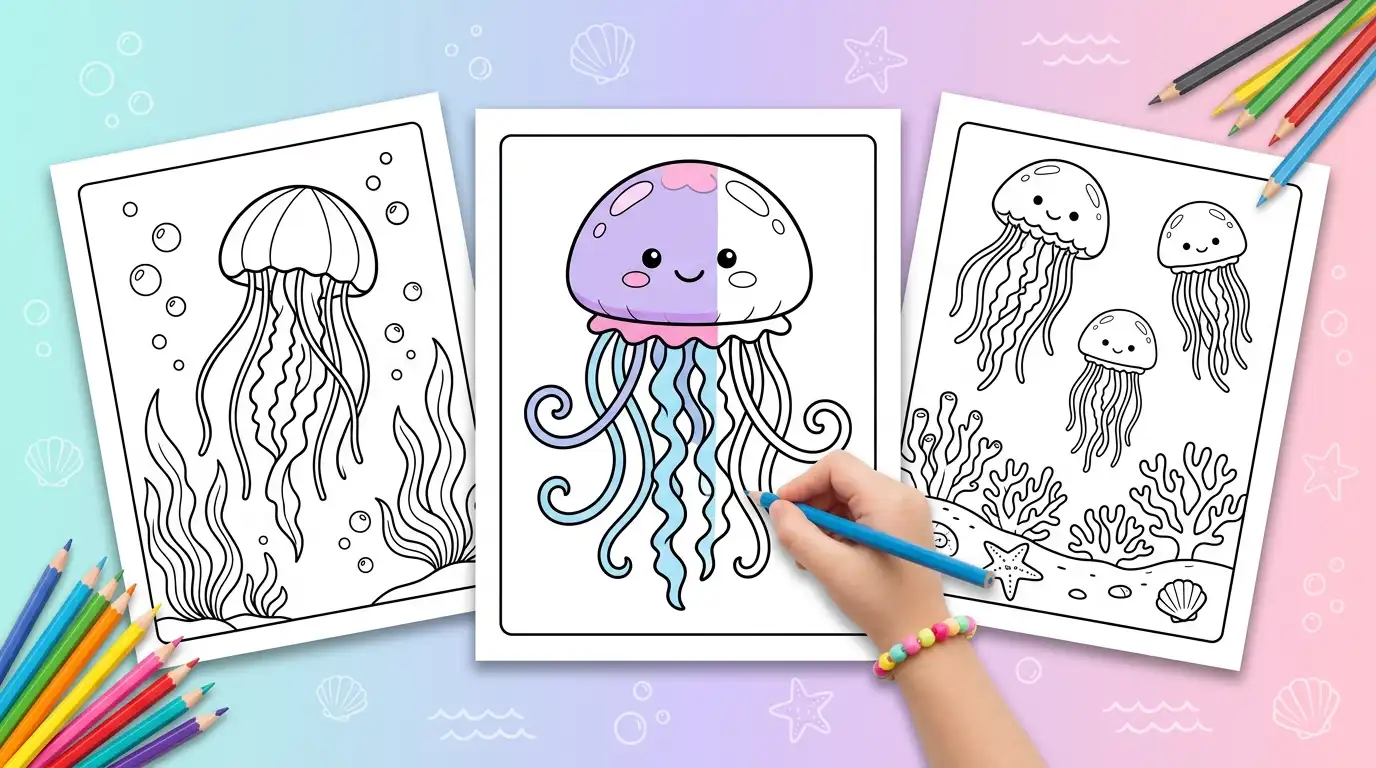
The trick to a jellyfish that looks like it’s glowing is to leave some paper white. Pick one side of the bell as the side where light hits, and leave a small curved patch uncolored there. That single highlight does more than any amount of extra color.
For tentacles, work light to dark. Start with a pale shade near the bell and press harder, or switch to a deeper shade, as you move toward the tips. It gives a sense of the tentacles fading into deep water.
Finally, make the water darker than the jellyfish. A pale jellyfish on a mid-blue or navy background stands out much more than a bright jellyfish on white. Watercolor pencils work well for this: color the water, then go over it lightly with a wet brush.
Jellyfish Facts for Kids
- Jellyfish are not fish. They are related to corals and sea anemones.
- They have no brain, no heart and no bones, and their bodies are about 95 percent water.
- Jellyfish have been drifting through the oceans for more than 500 million years, since long before the dinosaurs.
- They move by squeezing their bell, pushing water out behind them.
- Their stings come from tiny cells on the tentacles that fire like microscopic harpoons.
- A group of jellyfish can be called a smack, a bloom or a swarm.
- The glow of the crystal jelly helped scientists discover a green glowing protein, which led to a Nobel Prize in Chemistry in 2008.
- Sea turtles eat jellyfish, and a floating plastic bag can look like a meal to them. That is one good reason to keep beaches clean.
Jellyfish Look-Alikes: Why the Man o’ War Isn’t a Jellyfish
Two pages in this collection show animals that are often called jellyfish but aren’t. The Portuguese man o’ war looks like a single creature, but it is actually a colony of many small organisms, each with its own job: floating, catching food, digesting or stinging. The by-the-wind sailor is another floating colony. It uses a small sail to drift across the ocean surface, and after strong winds, huge numbers can wash up on beaches.
These pages are a good way to teach one important beach rule: never touch a jellyfish or anything that looks like one, even if it is lying on the sand. Many can still sting after they wash ashore.
Printing Tips
Each PDF is set up for both US Letter and A4 paper, so pick the size that matches your printer. If anything looks cut off, choose “Fit to page” in your print settings.
Ordinary printer paper is fine for crayons and colored pencils. For markers, paint or crafts, use a heavier paper or light cardstock so the colors don’t bleed through or tear the page. Printing in black and white mode saves ink and keeps the lines crisp.
Things to Do with Your Finished Pages
- Window jellyfish. Color a page with markers, cut out the jellyfish and tape it to a sunny window. Thin printer paper lets a little light through, which gives the jellyfish a soft glow.
- Jellyfish family sort. After coloring the Jellyfish Family page, cut out the three jellyfish and ask younger kids to line them up from smallest to biggest, then biggest to smallest.
- Life cycle wheel. Color the life cycle page, cut out the circle and pin it to a second paper circle with a paper fastener. Kids can spin it to walk through each stage and say its name.
- Real or look-alike quiz. Print a few species pages alongside the man o’ war and by-the-wind sailor. Mix them up and ask which ones are true jellyfish. It is a quick way to check what they learned from the facts above.
More Ocean Coloring Pages
[Stingray coloring pages] · [Octopus coloring pages] · [Sea turtle coloring pages] · [Fish coloring pages] · [Ocean animal coloring pages]
Frequently Asked Questions
Are these jellyfish coloring pages free? Yes. Every page is free to print for home and classroom use. Please don’t sell the pages or upload them to other websites.
Which jellyfish coloring page is best for a toddler? Start with Big Smiley Jellyfish, Bold Jellyfish with Bubbles or Jellyfish Family. They have thick outlines and large shapes that suit chunky crayons.
Can I color these pages online? Yes. Click “Color Online” under any page to color it in your browser, with no download needed. It also works on tablets.
Will the pages print on A4 paper? Yes. Each PDF is sized for both US Letter and A4, so choose the one that matches your paper.
What colors should a jellyfish be? Any colors your child likes. For a realistic look, see the color guide above. Many real jellyfish are pale and partly clear, with brighter colors in their rings, rims or tentacles.
Can I use these pages in my classroom? Yes. Print as many copies as your class needs. The anatomy, life cycle and look-alike pages work especially well for science lessons.